SHARP-EATMAN
NATURE
PHOTOGRAPHY
EPEOLUS AND TRIEPEOLUS CUCKOO BEES
Genus Epeolus
Genus Triepeolus
Brood parasites, sometimes called cuckoo bees or kleptoparasites, enter the nests of host bees to deposit eggs. When a cuckoo's offspring hatch, they eat the host's eggs or slaughter the host's larvae and then feast on the nectar and pollen stores the host carefully gathered for her own offspring.
Cuckoo bees drink nectar from flowers, and they often appear on the very blossoming plants that their hosts prefer. They do not, however, gather pollen from flowers. As a result, female brood parasites do not have scopae (pollen-collecting hairs) on their legs or abdomens. To the naked eye, they often appear hairless and sleek-bodied like wasps.
Brood parasites sometimes have spade-shaped abdomens or other traits that allow them to penetrate other bees' nests, and they generally act differently than their hosts -- many brood parasites spend much of their time skulking around on the ground, looking for their hosts' nests, or lurking outside of nests, waiting for the opportunity to enter them.
WIthin the United States, the tribe Epeolini contains two varieties of brood parasites -- Epeolus and Triepeolus. Bees in these two genera usually have well-defined white, grayish-white or yellowish patterns on their thoraxes and banding on their abdomens. These stripes and patterns are made up of short, dense, velvety "appressed" hairs. In the Valley, Epeolus and Triepeolus can be arrestingly beautiful and colorful. Many have red legs and tegulae (the plates where the wings meet the body). Others, like the dwarf Epeolus shown here, have exquisitely-colored eyes.
Epeolus usually parasitize the nests of Colletes (cellophane bees). Cellophane bees protect their nests from moisture by lining their brood-cell walls with a plastic-like substance. The female Epeolus has tooth-like projections on the tip of her abdomen that allow her to saw through the plastic seals of Colletes nests in order to penetrate their egg chambers. The Epeolus then exudes a glue-like substance, which she uses to append her own eggs to chamber walls. When the Epeolus larvae hatch, they feed on the pollen provisions left by the cellophane bee host.
Triepeolus usually target the nests of longhorn bees such as Melissodes and Eimelissodes, and they sometimes prey on other ground-nesting bee genera as well (including, among others, Anthophora, Centris, Melitoma, Protaxea and Ptiloglossa).
Triepeolus generally tend to run larger than Epeolus. In addition, Epeolus and Triepeolus abdomens differ in ways that reflect the characteristics of the nests each cuckoo genus parasitizes. Rather than sport saw-like tools on their abdomens like Epeolus, Triepeolus females have long, narrow, forceps-like projections, which they use to pierce the walls of their hosts' underground nests.
Epeolus and Triepeolus cuckoos may be hard to discover, since they have no nests or homes of their own. Thus, they do not form colonies or aggregations. Both males and females sleep outside at night. They sometimes can be found resting in groups in early morning, hanging by their jaws from vegetation frequented by their hosts.
Distinguishing Epeolus from Triepeolus
Triepeolus and Epeolus can be tricky to tell from one another. The minute differences in the apparatus on the abdomen tips of female Epeolus and Triepeolus bees, detailed above, are not usually visible to the naked eye. Nonetheless, a macro lens can aid in differentiating females of one genus from another. As shown in the accompanying photo strip, the tip of an Epeolus female's abdomen has a characteristic wide patch of silvery hairs.
Distinguishing Males from Females
It is fairly easy to tell with the naked eye whether an Epeolus/Tripeolus is male or female. Males can be identified quickly by the tips of their abdomens. Males' abodmens terminate in a hard, pointed, roughly triangular protrusion called a pygidial plate. Females lack a pygidial plate; instead, the tip of the female's abdomen is covered with a patch of bristly or silvery hairs. These traits are shown in the accompanying photo strip.
Note that, in addition to the above, all female and male bees can be told apart by the following: (1) The antennae of females have 12 segments (a scape, pedicel and a flagellum consisting of 10 segments), while the antennae of males have 13 segments (a scape, pedicel and flagellum consisting of 11 segments). (2) The abdomens of female bees have 6 segments, while males' abdomens have 7 segments.
Identifying Epeolus and Triepeolus species
Epeolus and Triepeolus species within each genus are sometimes difficult to differentiate from one another and may require expert assistance to identify. Helpful information for distinguishing Epeolus species can be found in Thomas Onuferko's “A revision of the cleptoparasitic bee genus Epeolus Latreille for Nearctic species, North of Mexico" (2018).
The best resource for identifying Triepeolus species is Molly Rightmyer's comprehensive 2008 work, “A review of the cleptoparasitic bee genus Triepeolus," which describes 103 Triepeolus species. In 2024, Onuferko and Rightmyer co-authored a supplement to Rightmyer's 2008 revision, titled "A revision of the simplex species group of the cleptoparasitic bee genus Triepeolus Robertson, 1901." This new work described 18 additional Triepeolus species,
Epeolus and Triepeolus species are often differentiated by traits too small to be seen by the naked eye. Nonetheless, some may be distinguished by more obvious traits, such as: (1) the colors of various body parts, particularly the legs, tegulae, face-parts and antennal segments; and (2) the patterns on the bees' thoraxes and abdomens formed by pale hairs, as well as the coloration of the hairs (white, grayish or yellowish. In addition, traits of the scutellum (second thorax segment) can be helpful in diagnosing species. The hind rim of the Epeolus / Triepeolus scutellum bears tooth-like projections called axillae, whose singular shape, color, length or position may be distinctive of a particular species; the shape of the scutellum's hind edge also aids in identification. (4) In female Triepeolus, the shape of the bee's abdomen tip, as seen from above and in profile may also help narrow down species.
The following are also useful for identifying Epeolus and Triepeolus species in the Valley: (1) the time of year in which they fly; and (2) their association with a particular known host bee,


A male Triepeolus


A female dwarf Epeolus cuckoo hanging by its jaws
EPEOLUS VS. TRIEPEOLUS

These pictures show the pseudopygidial areas located at the tips of the abdomens of female Epeolus (left) and Triepeolus (right). To the naked eye, the tip of the female Epeolus abdomen appears covered with a wide band of silvery hairs. On Triepeolus, the pseudopygidial area is narrower and longer, and in most species the bristly hairs covering it have a golden cast.

This is the thorax of a Triepeolus. Patterns on Epeolus and Triepeolus thoraxes are used to differentiate species. Traits of the axillae -- the tooth-like projections on the rear edge of the scutellum (the second thorax segment) are also used to distinguish species.
MALE VS. FEMALE

All female bees have antennae with 12 segments: a long segment called a scape, topped by a short segment called a pedicel, and above this, a flagellum consisting of 10 segments.

All male bees have antennae with 13 segments: a long segment called a scape, topped by a short segment called a pedicel, and above this, a flagellum consisting of 11 segments.
TAXONOMY OF EPEOLUS AND
AND TRIEPEOLUS BEES
Order: Hymenoptera
Family: Apidae
Subfamily: Nomadinae
Tribe: Epeolini
Genus: Epeolus and Triepeolus
Species shown below on this page:
Epeolus interruptus
Epeolus pusillus
Triepeolus concavus
Triepeolus kathrynae
Triepeolus mexicanus
Triepeolus penicilliferus
Triepeolus rufoclypeus
Triepeolus vernus
Triepeolus zacatecus
ID GUIDE TO WILD BEES
OF THE NATIONAL BUTTERFLY CENTER
Mission, Texas

CUCKOO BEES
Epeolus & Triepeolus
Epeolus Species of the National Butterfly Center & Lower Rio Grande Valley
Dwarf Epeolus Cuckoo Bee
Epeolus pusillus
Family: Apidae
Size: 8-9 mm (female)
Associated flora at NBC:
Hierba del marrano
(Symphyotrichum sp.)
Resinbush
(Viguiera stenoloba)
Plant Family: Asteraceae
When and where seen:
November 2018, April 2019
National Butterfly Center
Mission TX (Hidalgo Co.)

This is a female dwarf Epeolus. This bee is distinguished in part by its small size: "pusillus" means "small" in Latin.

Epeolus pusillus of the Valley are striking cuckoo bees with red legs and bold black-and-white patterns on the abdomen and thorax. In the Valley, this species tends to have violet eyes.

A female Epeolus pusillus resting while grasping a stem with her jaws

The red legs of a dwarf Epeolus seen from below

A violet-eyed female dwarf Epeolus (Epeolus pusillus)

A female dwarf Epeolus cuckoo bee
At the National Butterfly Center, Epeolus pusillus can be found visiting aster-family plants, particularly during the fall. This bee is relatively small and easy to miss. ("Pusillus" means "small" ). It preys principally on the correspondingly small compact cellophane bee (Colletes compactus). The two bee species sometimes can be discovered feeding side-by-side on the same plant. Epeolus pusillus also hs been documented parasitizing the nests of Colletes americanus, C. ciliatoides and C. deserticola.
Interrupted Epeolus Cuckoo Bee
Epeolus interruptus
Family: Apidae
Size: 7-10 mm (female & male)
Associated flora:
Romerillo
(Bidens alba)
Plant Family: Asteraceae
When and where seen:
April 27, 2026
National Butterfly Center
Mission TX (Hidalgo Co.)

A male Epeolus interruptus: note the red scutellum. Photo copyright Dan Jones.

A male Epeolus interruptus: the interrupted pale bands on the abdomen give this species its name. Note the triangular black discal patch on T1 (the first abdomen segment). Photo copyright 2026 Dan Jones.

Note the the sides of T1 (the first abdomen segment) are concave. This is a distinguishing trait of this species. Photo copyright 2026 Dan Jones.
Recommended references
about Epeolus interruptus:
Brumley, Richard L., A Revision of the bee benus Epeolus Latreille of Western America North of Mexico. (1965). All Graduate Theses and Dissertations, Spring 1920 to Summer 2023. 2682.
Mitchell, T.B. (1962) Bees of the Eastern United States. North Carolina Agricultural Experiment Station Technical Bulletin No. 152.
Onuferko T. M. (2017) Cleptoparasitic bees of the genus Epeolus Latreille (Hymenoptera: Apidae) in Canada. Canadian Journal of Arthropod Identification No. 30: 1–62.
Onuferko T M, (2018). A revision of the cleptoparasitic bee genus Epeolus Latreille for Nearctic species, north of Mexico (Hymenoptera, Apidae). ZooKeys 755: 1–185.


A male interrupted Epeolus (Epeolus interruptus)
Photo Copyright 2026 Dan Jones
Epeolus interruptus ranges through much of North America: it occurs in southern Canada, east of the Rocky Mountains; in most of the continental United States (excluding Washington State, Maine and Florida); and in northern Mexico and Baja California. Nonetheless, there are few records of Epeolus interruptus in Texas, and this species is rarely reported in the Lower Rio Grande Valley.
The male bee shown here was found by master photographer Dan Jones at the National Butterfly Center, feeding on romerillo (Bidens alba) on April 27, 2026. This is the first published record of the species at the NBC.
Epeolus interruptus flies from April to July in most of North America. It is frequently associated with aster-family plants such as Baccharis, Chrysanthemum, Coreopsis, Heterotheca villosa (goldenaster), Krigia (dwarfdandelion) and Rudbeckia (black-eyed Susan). It has also been documented foraging on pea-family plants such as Trifolium (clover). Colletes aestivalis, an eastern species of cellophane bee not found in Texas, is thought to be a possible host for this cleptoparasite.
ID tips: To the naked eye, Epeolus interruptus stands out in the field because of its red scutellum (second thorax segment), and the interrupted wide bands of pale hair on T1-T4 (the first through fourth segments of the abdomen). According to Onuferko (2018), the diagnostic traits of this species include the following: (1) The metanotum (the third segment of the thorax) has a blunt protrusion in the middle; and (2) T1 has concave sides and a triangular discal patch; this is the wide, black, roughly disk-shaped area on the top, middle surface of the first abdominal segment. Note that the bee’s scutellum is occasionally black in some specimens.
Triepeolus Species of the National Butterfly Center & Lower Rio Grande Valley
Associated flora:
Cowpen daisy
(Verbesina encelioides)
Plant Family: Asteraceae
When and where seen:
Dos Venadas Ranch
Rio Grande City, TX
April 2023
Paintbrush Triepeolus
Triepeolus penicilliferus
Family: Apidae
Size: 9-14.5 (males and females)

A male Triepeolus penicilliferus
Male bee

A male Triepeolus penicilliferus measuring 15 mm

Alternate view of bee: the male bee's legs and tegulae are predominantly red.

Dorsal view of thorax

Vertex of male Triepeolus penicilliferus
Triepeolus penicilliferus is a robust and relatively large cuckoo bee whose host species is the large longhorn bee Epimelissodes sabinensis. The male bee shown here measured 15 mm. The bee's legs are predominantly red. It also has red coloration on the tegulae, and on the labrum, clypeus, mandibles and lower antennae.
Spring Triepeolus
Triepeolus vernus
Family: Apidae
Size: 7-10 mm (female)
Associated flora at NBC:
Texas Prickly Pear
Opuntia engelmanii
Twisted rib cactus
Hamatocactus bicolor
Plant family Cactaceae
When seen:
April 2018
Mission, TX (Hidalgo Co.)

A female Triepeolus vernus: this bee has bold black and white patterns on its thorax and abdomen. Its legs are red, as are its tegulae (the plates where the wings join the body).

Dorsal view of bee

Close-up of the bee's thorax (scutum and scutellum)

Pale hairs cover the female bee's mesipisternum (the side of the thorax).

A female spring Triepeolus

A female Triepeolus vernus
Triepeolus vernus appears in April, during the spring cactus bloom in Hidalgo County. It is a small Triepeolus with bright-red markings. Its host species is unknown. In Hidalgo County, however, it frequents areas where Melissodes opuntiellus and Anthophorula compactula are nesting and can be found lurking amid the flowers Texas prickly pear and twisted-rib cactus, plants frequented by both of those species.
Food plants at NBC:
Blanket flower
(Gaillardia pulchella)
Wild sunflower
(Helianthus annuus)
Resinbush
(Viguiera stenoloba)
Seaside goldenrod
Solidago sempervirens
Cowpen daisy
(Verbesina encelioides)
Plant Family: Asteraceae
When and where seen:
National Butterfly Center
Mission, TX (Hidalgo Col.)
Rio Grande City, TX (Starr Co.)
April - October, 2018-2023
Red-faced triepeolus
Triepeolus rufoclypeus
Family: Apidae
Size: 8.5-13.5 mm (males & females)

A female Triepeolus rufoclypeus

Dorsal view of a female Triepeolus rufoclypeus

A female Triepeolus rufoclypeus
Triepeolus rufoclypeus is the most common Triepeolus of the Valley. It appears in large numbers at the National Butterfly Center in early fall. It is often found on wild sunflowers and other members of the aster family, plants frequented by various longhorn bee species during the same period.
Associated Flora:
Turkeytangle Frog fruit
(Phyla nodiflora)
Plant Family: Verbeneceae
When and where seen:
May 5, 2026
National Butterfly Center
(Hidalgo County)
Mexican Triepeolus
Triepeolus mexicanus
Family: Apidae
Size: 10.8 mm (female & male)

A male Mexican Triepeolus
Photo copyright 2026 Dan Jones
Mexican Triepeolus
(Triepeolus mexicanus)

This is a male Mexican Triepeolus (Triepeolus mexicanus) found at the National Butterfly Center of Texas in May 2026. Photo copyright 2026 Dan Jones.
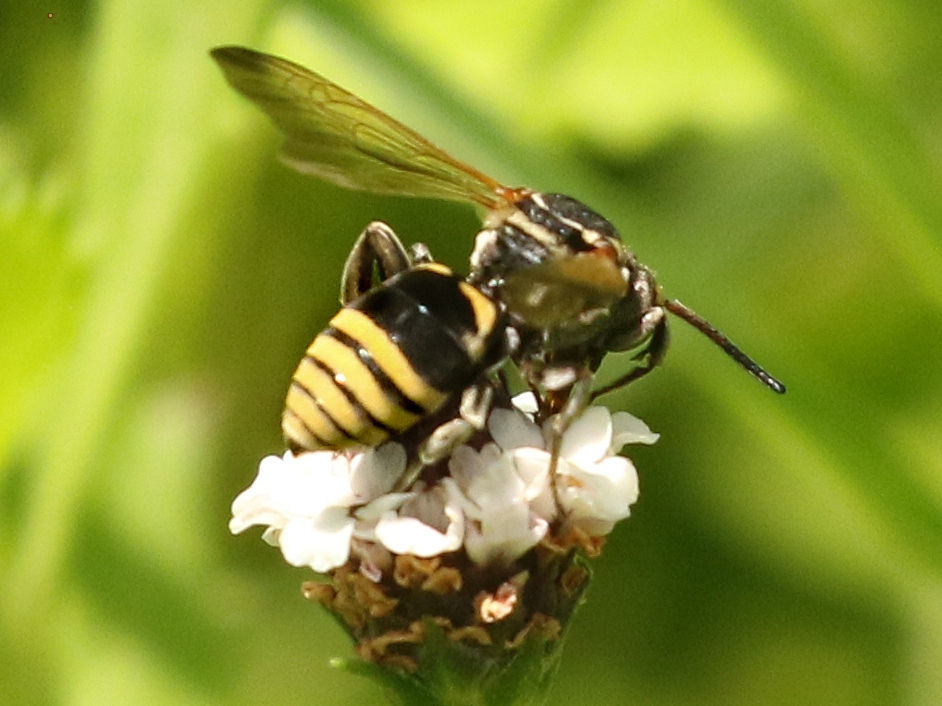
This bee stands out in the field: the male's abdomen is largely black on the front third, and ringed behind with a succession of four bold yellow bands (T2-T5). There is a patch of yellow hairs on the 6th segment as well. Photo copyright 2026 Dan Jones.

The male bee in flight & an alternate view of the bands on its abdomen. Photo copyright 2026 Dan Jones.
Mexican honey wasp
This wasp is easily confused
with the Mexican triepeolus.

This is a Mexican honey wasp (Brachygastra mellifica). The wasp has a tapering, sharply pointed abdomen. Photos copyright 2025 Adrian Torres Benavides @macro_metropolitano (instagram.com).

The Mexican honey wasp also has an entirely black thorax -- the Mexican triepeolus, by contrast, has a band of yellow hairs on the front of the thorax. Photo copyright 2025 Adrian Torres Benavides.

The Mexican honey wasp lacks wing-shaped yellow markings at the front of the abdomen. Photo copyright 2025 Adrian Torres Benavides.

A female Mexican Triepeolus
Photo copyright 2023 Sean Werle
Range: Records of this species in Texas are rare. Most United States records of the Mexican triepeolus are from southern Arizona and southwestern New Mexico, and even these are uncommon. The male bee shown here was found by master photographer Dan Jones on May 5, 2026 at the National Butterfly Center (Hidalgo Co.).
Triepeolus mexicanus is known to occur in Tamaulipas, a Mexican state bordering the Lower Rio Grande Valley. The species typically ranges throughout Mexico and Central America as far south as Panama. Biologist and photographer Sean Werle has provided photographs here of a female Triepeolus mexicanus from Belize.
Description of Triepeolus mexicanus: The Mexican triepeolus is a dark bee with a mostly black thorax and striking, wide yellow bands on the abdomen. The bands on are formed by yellow, appressed (short, dense) hairs. The bee's head, antennae and legs are mostly black or dark brown. The tegulae (plates where the wings meet the thorax) are reddish, and the wings are dusky.
E. T. Cresson first described Triepeolus mexicanus in 1878. The species was redescribed by Onuferko & Rightmyer (2024). This is a distinctive Triepeolus, easily identified within the region by a handful of traits:
(1) From above, the bee's thorax appears largely black -- the scutum (lst segment) lacks the two parallel lines of hair (known as paramedian bands) that adorn the scutum in most Triepeolus species.
(2) T1 (the first segment of the upper abdomen) has distinctive wing-shaped markings on each side. These are formed by yellow bands at the base of T1 that form a semi-circular shape as they arch downward, joining lateral masses of yellow hairs.
(3) The rear two-thirds of the abdomen is striped by continuous, wide and well-defined, tightly spaced and deeply colored parallel yellow bands. On males, there are four bands (on T2-T6) and on females there are three (T2-T4).
(4) Seen from afar, the bee looks as if the front third of its abdomen is black. (The back portion is yellow-striped.) This is because the rear portion of T1 and front portion of T2 are black, so that these two segments join visually to create a broad black area on front of the abdomen.
5) Some other minute traits are worth mentioning: despite the generally black appearance of the thorax, yellow hairs rim the sides and rear edge of the scutum (the first thorax segment). In addition, yellow hairs form an evenly broad collar at the very front of the scutum (the pronotum). This last trait helps set the species apart from the somewhat similar Triepeolus cameroni.
ID Tips: In the Lower Rio Grande Valley, Triepeolus mexicanus can be confused with the more common Mexican honey wasp (Brachygastra mellifica). Expert macro photographer Adrian Torres Benavides has provided images of a specimen from Nuevo León that illustrate the differences between the honey wasp and the Mexican triepeolus. These images are shown in the second photo strip accompanying this entry.
The Mexican honey wasp is black with yellow bands on the rear portion of its abdomen. The wasp can be distinguished from Triepeolus mexicanus by the former's much pointier abdomen and by its lack of yellow markings on the thorax. In addition, the entire front half of the wasp's abdomen appears black to the naked eye; there are no wing-shaped yellow markings on the sides of the first segment.
Host bee and floral associations: The bee host of the brood parasite Triepeolus mexicanus is unknown.
Floral associations: Onuferko & Rightmyer (2024) summarize floral records for Triepeolus mexicanus -- these include a diverse range of flora from ten different plant families. Among others, Triepeolus mexicanus has been documented feeding on these aster-family flowers found at the NBC and throughout the LRGV: romerillo (Bidens alba), blanketflower (Gaillairdia pulchella), and coat buttons (Tridax procumbens). The bee shown here found at the National Butterfly Center appeared on turkeytangle frogfruit, a member of the Verbenaceae family.
Associated Flora:
Texas lantana
(Lantana urticoides)
Whitebrush
(Aloysia gratissima)
Plant Family: Verbeneceae
When and where seen:
June 16, 2025
May 18, 2026
La Puerta Tract
(Starr County)
Concave Triepeolus
Triepeolus concavus
Family: Apidae
Size: 10.8 mm (female & male)

A male concave triepeolus. Photo copyright 2026 Dan Jones.

View of the thorax of a male Triepeolus concavus. Photo copyright 2025 Dan Jones.

Tripeolus concavus can be identified by the unusual markings on the scutum (lst thorax segment): an irregular black patch with a jagged border of pale hairs. (USGS public domain photo: https://www.marylandbiodiversity.com/taxon/17828)
Recommended References
on Triepeolus concavus:
Villagas, Rob Diaz de [WFSU Public Media's Ecology Producer]. Innovation Park's Longhorn Bee Nest Metropolis. Biology Blog, WFSU Public Media.
Brues Charles T. 1903. Studies of Texan bees. Part 1. Entomological News 14: 79-85.
Custer, Clarence P. 1929. Notes on cocoons and parasites of Melissodes obliqua and nests of Perdita opuntiae (Hymenoptera, Apoidea). Psyche: 36(4): 293–295.
Malfa, K., Mackowiak, C., O’Brien, K., Iboyi, J., Parys, K. A., & Esquivel, I. L. 2025. Note on the nesting biology of Epimelissodes aegis LaBerge (Hymenoptera: Apidae). Florida Entomologist, 108(1), 20240056.
Rightmyer, Molly.G. 2008. A review of the cleptoparasitic bee genus Triepeolus (Hymenoptera: Apidae). Part I. Zootaxa 1710(1): 1–170.

A male Mexican Triepeolus concavus
Photo copyright 2026 Dan Jones
Description: Triepeolus concavus is a medium-sized black bee with pale hairs banding its abdomen, black legs and dark wings. The concave treipeolus can be readily identified by the singular pattern on its thorax: a large, irregular black patch invaded in the front by a jagged pale border made up of dense, pale hairs.
Range: Nature photographer Dan Jones documented this species in 2025 and 2026 at La Puerta Tract. These are the first records for Triepeolus concavus in Starr County. The last records for this species in the LRGV are from more than 40 years ago: in 1981 and 1983, the renown entomologist and bee collector Charles C. Porter found three specimens of Triepeolus concavus in Hidalgo County, at the McAllen Nature Center and Bentsen-Rio Grande State Park.
The usual Texas range for Triepeolus concavus is more northernly. The concave triepeolus is generally considered a widespread species: it ranges from Washington to California on the west coast; inhabits much of the southwestern and midwestern United States; and occurs on the east coast from Florida to Pennsylvania. Triepeolus concavus has been documented infrequently in north-central and northwestern Mexico (in Chihuahua, Durango, and Sonora).
Hosts: The oblique longhorn bee (Epimelissodes obliquus) is a documented host of the cleptoparasitic Triepeolus concavus (Custer 1929; RIghtmyer 2008). A recent study (K. Malfa et al. 2025) suggests that the sandhills longhorn bee (Epimelissodes aegis) may also be a host for Triepeoelus concavus. We highly recommend Rob Diaz de Villagas' lively account of Triepeolus concavus entering the burrows of sandhills longhorn bees, written after Malfa's study, and titled "Innovation Park's Longhorn Bee Nest Metropolis."
Epimelissodes aegis is not native to South Texas, and sightings of E. obliquus in the Lower Rio Grande Valley are rare. Nevertheless, Malfa's study suggests that T. concavus might be flexible in its host choice. Several large Epimelissodes inhabit the LRGV. These include: E. atripes (black-legged longhorn bee), E. petulca (frisky longhorn bee), and E. sabinensis (sabine longhorn bee).
Associated plants: Triepeolus concavus has been documented visiting flowers from at least seven different plant families. It is often found on Asteraceae, probably because these are the preferred flora of its longhorn bee hosts. The concave triepeolus is known to visit aster-family flowers common to the LRGV such as sunflower (Helianthus), romerillo (Bidens alba) and Mexican hat (Ratibida columnifera). The two male bees from the LRGV shown here were found visiting native verbena-family flowers: Texas lantana (Lantana urticoides) and whitebrush (Aloysia gratissima).
Associated flora:
Texas kidneywood
(Eysenhardtia texana)
Plant Family: Fabaceae
When and where seen:
May 23, 2025
La Puerta Tract
Rio Grande City, TX
(Starr Co.)
Kathryn's Triepeolus
Triepeolus kathrynae
Family: Apidae
Size: 12-13 mm (males and females)

A black male Triepeolus kathrynae from Starr Co. Texas

This is a male Triepeolus kathrynae, found in May 2025 at La Puerta Tract (Starr Co.). Note the yellowish coloring of the abdominal bands. Photo copyright 2025 Dan Jones.

Lateral view of bee: this bee lacks the red legs typical of the species. Such color variations occur in many Triepeolus species that are typically partly red. Photo copyright 2025 Dan Jones.

Alternate view of bee, showing the pale markings on the thorax (the pronotal collar and paramedian bands on the scutum). Note the long, incurved axillae (the toothlike projections on the back of the second thorax segment). Photo copyright Dan Jones 2025

Alternate view of pale markings on front of thorax. Photo copyright Dan Jones 2025

This is a male Triepeolus kathrynae found in Arizona in August 2025, feeding on prairie acacia (Acaciella angustissima). This bee has the typical coloration of the species -- its legs are reddish rather than black. Photo Copyright 2025 Ken Kertell.

Close-up lateral view of the same Arizona bee. Photo Copyright 2025 by Ken Kertell.

This pinned specimen of a femaleTriepeolus kathrynae from Arizona also has the red legs typical of the species. Photo copyright 2023 Sam Wilhelm.

Dorsal view of female bee: note the yellow coloration and the distinctive pattern of the hairs banding the bee's abdomen. Photo copyright 2023 Sam Wilhelm.
Recommended References
on Triepeolus kathrynae & T. zacatecus:
Cresson, E.T. 1878. Descriptions of new North American Hymenoptera in the collection of the American Entomological Society". Trans. Amer. Ent. Soc. (Co. Paper 401):61-135.
Onuferko, T.M., & M.G. Rightmyer. 2024. A revision of the simplex species group of the cleptoparasitic bee genus Triepeolus Robertson, 1901 (Hymenoptera: Apidae). European Journal of Taxonomy 950(1): 1–106.
Rightmyer, M.G. 2008. A review of the cleptoparasitic bee genus Triepeolus (Hymenoptera: Apidae). Part I. Zootaxa 1710(1): 1–170.
Rozen J.G. Jr. 1989. Two new species and the redescription of another species of the cleptoparasitic bee genus Triepeolus with notes on their immature stages (Anthophoridae: Nomadinae). American Museum Novitates 2956: 1–18.
See also: Comments by Thomas Onuferko and John Ascher dated Dec. 21, 2025 on photographs of Dan Jones. iNaturalist. May 23, 2025. And Accessed 12-21-25. Link.
Photo Copyright 2026 Dan Jones

A red-legged male Triepeolus kathrynae from Arizona
Photo Copyright 2025 Ken Kertell
Information on the species Triepeolus kathrynae
Tripeoelus kathrynae was first described in 1989 by renowned entomologist Jerome Rozen, Jr., curator of the Apoidea Collection of the American Museum of Natural History. He named the bee after his granddaughter. T. kathrynae is a kleptoparasite of the glorious protoxaea (Protoxaea gloriosa), an exceptionally large bee native to the Lower Rio Grande Valley.
Range: Rozen found his Triepeolus kathrynae In Arizona. Within the United States, Triepeolus kathrynae is most often found along the US-Mexico border in Arizona and New Mexico. Its range extends southward into Mexico as far as Guerrero. There are records of Triepeolus kathrynae from the Mexican states of Baja California, Chihuahua, Durango, Guerrero, Jalisco, Nuevo Leon, Sonora and Morelos.
Records of Triepeolus kathrynae in the Lower Rio Grande Valley are relatively recent. On May 23, 2025, expert nature photographer Dan Jones posted photographs on i-Naturalist of a large Triepeolus he had discovered at La Puerta Tract (Starr Co.) feeding on Texas kidneywood blossoms. The bee (shown here in the first photo strip) was identified as Triepeolus kathrynae by Epeolini expert Thomas Onuferko, who accompanied the ID with useful commentary summarizing the distinctive traits of the species.
Before this discovery, the closest record of Triepeolus kathrynae was of a male found in 1951 in Vallecillo, Nuevo Leon (approx. 88 miles from La Puerta). There are limited Texas records of Triepeolus kathrynae: the species was documented decades ago in Culberson County (1963) and Dimmit County (1943), situated approximately 600 and 120 miles respectively from Starr County.
Traits of Triepeolus kathrynae
In 2024, the European Journal of Taxonomy published an article coauthored by Epeolini experts Thomas Onuferko and Molly Rightmyer. Titled "A revision of the simplex species group of the cleptoparasitic bee genus Triepeolus Robertson, 1901," the work described 18 Triepeolus species, among them T. kathrynae. The 1984 revision provided extensive information on the physical characteristics of T. kathrynae and summarized behavioral and geographical information relating to the species.
General Traits. Triepeolus kathrynae is a relatively large, mostly black to dark brown cuckoo bee with patterns formed by pale-yellow hairs on its thorax and abdomen. The bee's wings are glassy and dusky.
Typically, Tripeolus kathrynae are partly red or reddish. Photographer Ken Ketrell and biologist Sam Wilhelm have provided photographs here of two typical examples of Triepeolus kathryne from Arizona that have partly red coloration. (See second photo strip). Onuferko & RIghtmyer (2024) describe Triepeolus kathrynae as having red or reddish coloring on the legs; the sides of the abdomen; the pygidial plate (on the tip of the abdomen); and the sternum. The tegulae (plates where the wings join the thorax) are reddish brown. The mandibles are partly orange and golden yellow; F1 of the antennae is orangish red, and F2 has an orange spot at the base.
Coloration may vary, however, on individual specimens of Triepeolus kathrynae. The bee shown here from La Puerta Tract is black overall, without red markings. That is, under the yellow hair patterns and bands, the integument of the bee (the exoskeleton) is black.
DIstinctive traits. Distinguishing this species from similar species can be tricky, particularly in individuals that lack red coloration. Species diagnosis may turn on minute traits of the axillae and sternum.
Traits of the axillae. Axillae, shown in the photographs here, are tooth-shaped features on the rear of the scutellum (the second thorax segment). Onuferko & Rightmyer (2024) emphasized traits of the axillae as distinctive features of Triepeolus kathrynae. They noted that on Triepeolus kathrynae, the axillae are large, pointed and hooked; their spines (tips) extend well beyond the mid-length of the scutellum; and at least half of the mesal (inner) edges of the axillae are unattached to the scutellum. The axillae also have pale hairs "all along" their margins.
Traits of the sternum: Triepeolus kathrynae possesses a second distinctive trait highlighted by both Rozen (1989) and Onuferko & Rightmyer (2024): on males, the rear edges of S4–S5 (the fourth and fifth segments) of the sternum (underside of the abdomen) have fringes of dense, long, curved, coppery to silvery hairs. The third sternal segment (S3) lacks such hairs.
Associated flora
Guajillo
(Senegalia berlandieri)
Plant Family: Fabaceae
When and where seen:
May 16, 2021
La Puerta Tract NWR
(Starr County)
Zacatec Triepeolus
or Kathryn's Triepeolus?
Triepeolus zacatecus
Triepeolus kathrynae
Family: Apidae
Size: 16.5 mm (this specimen)
Typical size: 14-17 mm (female & male)

A male Triepeolus zacatecus / kathrynae: this is a large bee, measuring approximately 16.5 mm. Its head, body and legs are black. Its tegulae are also black and its wings smoky and dark-veined.
Dorsal view of the pattern formed on the bee's thorax by appressed pale hairs. The long axillae (toothlike projections) are sharply incurved at the tips. Note the fringes of white hair on both the outer and inner margins of the two axillae.

Lateral view of head and thorax of male bee

Face of male bee
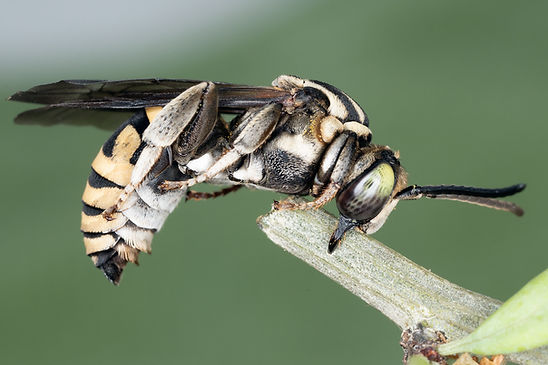
A 16.5 mm male Triepeolus zacatecus / kathrynae
Triepeolus zacatecus
The male bee specimen featured here, found in Starr County's La Puerta Tract, was originally identified in 2021 as Triepeolus zacatecus and appears under this name in Native Bees of the Lower Rio Grande Valley. This species had been documented previously in Tamaulipas, the Mexican state that borders Starr County and lies a mere 1-2 miles from La Puerta Tract. Triepeolus zacatecus ranges from Tamaulipas to Mexico's southern border. It has been found as far South in Central America as Costa Rica.
Traits of Triepeolus zacatecus
Triepeolus zacatecus is a very large (14-17 mm), black bee with patterns of short pale-yellow hairs on the thorax and abdomen. The bee shown here stood out in the field because of its exceptional size (16.5 mm).
Cresson first described a female Triepeolus zacatecus in 1878. Triepeolus zacatecus is distinguished in part by four minute traits. (1) The axillae are long and sharply incurved. (Axillae are toothlike projections at the back of the second thorax segment, shown in the photo strip here). (2) The pronotal collar (at the front of the thorax) is wide and protuberant. (3) The mesepisternum (side of the thorax) is covered with short, dense hairs. (4) There are long, erect, simple setae on the mesopleura (long hairs on the lateral thorax, near the juncture where it joins the abdomen). The bee shown here possesses the first three of these traits, but nor the fourth.
Triepeolus zacatecus is very similar to T. grandis, another exceptionally large Triepeolus. The two species differ principally in coloration: T. grandis has red legs and red on parts of its head and body. Notably, on both T. grandis and T. zacatecas, the axillae have a fringe of white hairs along the inner margins -- but existing literature notes that the axillae lack hairs along the outer margins. (Rozen 1989; Onuferko & RIghmyer 2024) . (It might be notable that some T. grandis identified on iNaturalist seem to have hairs on the outer rims of the axillae.)
Triepeolus kathyrnae vs. Treipeolus zacatecus
In her comprehensive 2008 revision of the genus Triepeolus, Rightmyer described Triepeolus zacatecus and noted that it is "superficially similar to T. kathrynae ... due to the very long axillar spines, the yellow coloration, and the robust body form." She also noted that females of the two species can be easily separated by traits of the abdomen. (The pseudopygidial area on the adomen tip is apically concave in T. kathrynae). Differences among males were not mentioned.
As noted in the preceding guide entry, In 2024, the European Journal of Taxonomy published an article coauthored by Epeolini expert Thomas Onuferko and Molly Rightmyer that contained a detailed description of T. kathrynae. Shortly after the publication of this article, a male Triepeolus kathrynae found at La Puerta tract was identified on i-Naturalist. This bee is shown in the preceding entry of this web page.
This prompted a re-examination of the species diagnosis of the large Triepeolus shown here. This bee possesses at least two of the defining characteristics of T. kathrynae as described in Onuferko & Rightmyer (2024). These relate to qualities of the axillae and sternum.
(1) First, as shown in the photo strips here, there are hairs all along both sides of the bee's axillae. By contrast, on Triepeolus zacatecas, there are hairs along the inner margins of the sternum only.
(2) Second, The rear edges of S4–S5 (the fourth and fifth segments of the sternum, or underside of the abdomen) have fringes of dense, long, curved, coppery to silvery hairs. The third sternal segment (S3), however, lacks such hairs. By contrast, on Triepeolus zacatecas, three sternal segments (S3-S5) are fringed with white hairs. Rightmyer (2008) describes these hairs as "white and sometimes reduced on S3, brown to pale golden on S4–S5.”)
The La Puerta Triepeolus shown here has axillae with hairs on both edges, and silvery fringes of hairs on S4-S5, but not on S3.
The consideration of such minute traits reveals the extraordinary subtlety involved in differentiating Triepeolus species. Based on the nuanced differences detailed here we have concluded that the bee found at La Puerta in 2021 is probably T. kathrynae.
Unanswered questions: Some questions remain about this species diagnosis. Most notably, the La Puerta bee shown here is considerably larger (16.5 mm) than the typical length (12-13 mm) of the male Triepeolus kathrynae.
The bee's integument is also entirely black, while the typical T. kathrynae has red legs and reddish coloration on parts of the face, antennae and abdomen. Nonetheless, Triepeolus species that are typically partly red can have all-black variants. An example is the T. kathrynae shown in the above entry on that species.
CITE THIS PAGE: Sharp, Paula and Ross Eatman. "Epeolus and Triepeolus." Wild Bees of the National Butterfly Center of Mission, Texas. 15 Jan. 2019, http://www.wildbeestexas.com. Accessed [day/month/year guide accessed].