SHARP-EATMAN
NATURE
PHOTOGRAPHY
UNPUBLISHED
website page
FLORIDA BEES
IDENTIFICATION PAGE # F-2026-#
June 2024
Melissodes
from Alachua Co.
Note: The male bee shown here was found on a stand of narrowleaf ironweed (Vernonia angustifolia) visited by female Melissodes compotoides. The male bee had a silvery appearance and darker wings than the typical regional M. communis communis. Several (5+) similar male bees appeared on the Vernonia over the course of 7 days. Melissodes bimaculatus & M. communis are the most common Melissodes in Gainesville during June, but females of neither species were found on the Vernonia. (Occasional Epimelissodes aegis as well as Agapostemon splendens visited the Vernonia in the same week.) In a field of Asteraceae (Gaillardia, Helianthus, Bidens), located about 200 yards away, there were M. communis, Epimelissodes aegis & T. atripes georgicus -- as well as Triepeolus lunatus lunatus and T. floridanus. In nearby squash fields, about 50 yards away, were Xenoglossa peponapis, X. kansensis and Trriepeolus rigatus. )
Size: male11. mm
Melissodes
communis or compotides?
Food plants:
Narrowleaf Ironweed
(Vernonia angustifolia)
When and where seen:
June 24, 2024, 2026
(Alachua County)


Male Melissodes on Vernonia

Male Melissodes on Vernonia
The tergal fasciae on the male bee above don't fit C. communis communis. The bee nonetheless shares mandible traits with C. communis communis communis: The apical (outer) third of the mandibles on the bee shown here are black; at the base is a narrow strip of black, and then a fairly large, roughly pyramidal yellow area that hugs the base.
On the bee shown here, the clypeus is yellow with two pairs of black spots: one is over the tentorial pits, and a second pair directly below near the outer rim of the clypeus. The bee’s labrum (the face-part under the clypeus) is yellow, with two faint irregular brown spots near the base.
Some notes on M. comptoides:
The bee’s abdomen is black, with a fringe of longish white hairs on the base of T1 (the first upper abdomen segment), and a basal band of pale hairs on T2. Narrow, interrupted pale bands traverse T2-T5 (along the middle of each segment, set back from the rim). On the sides of the abdomen, the hairs on these bands become wider, and the hairs longer, giving the bee a shaggy appearance. Short to longish black hairs appear on T2-T5 on areas not covered by white bands; these dark hairs blend in with the darkly-colored abdomen underneath.
As described largely by Michell (1962), other notable traits of the abdomen include the following. On T2-T4 (particularly on T4), the interruption in the pale hair band exposes the rim of the segment, which appears almost glassy – it is smooth, brittle and a transparent yellowish-brown. There are toothlike spines, partially concealed by hairs, on either side of T6. The pygidial plate (at the rear of the abdomen) is ridged along the margin, and narrows near the tip, which is round or roundly-blunt.
Male Melissodes communis communis
A male M. communis communis is shown below. This bee is from a different site.
Note: This is a male common longhorn bee (Melissodes communis communis) found feeding on Ocala lupine (Lupinus ocalensis) in a Florida sandhill habitat in Gainesville on April 2, 2026 (SCP)
Size: male 13 mm
Melissodes communis communis
Food plants:
Ocala lupine
(Lupinus ocalensis)
When and where seen:
April 2, 2026
(Alachua County)
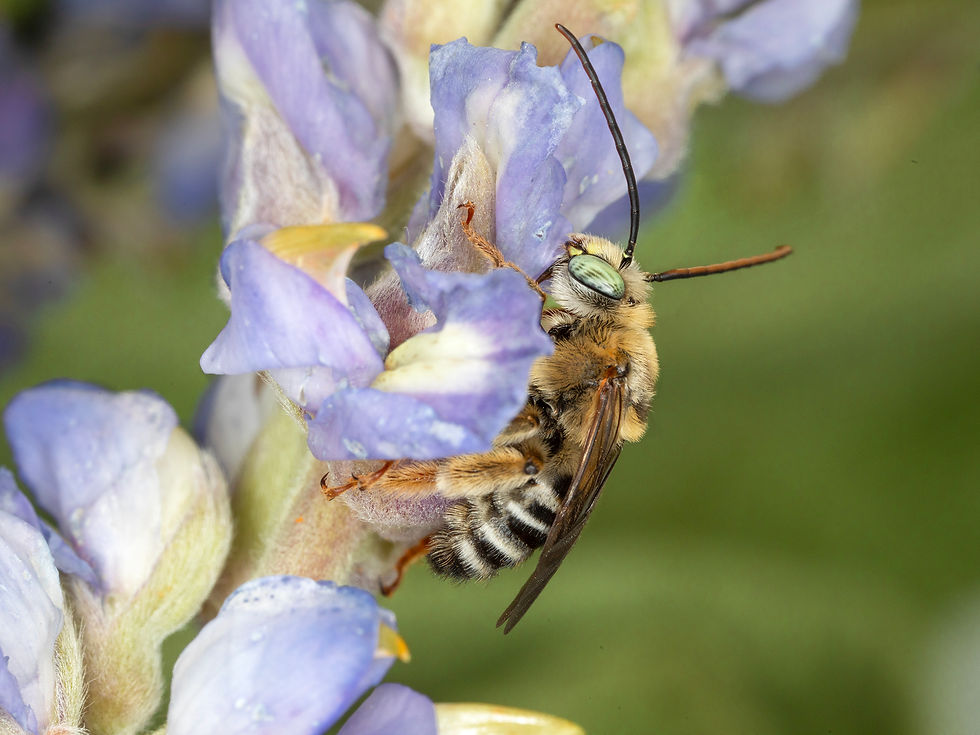


Male Melissodes on ocala lupine

Male Melissodes on Vernonia
All images and text protected by registered copyright.
Permissions Information