SHARP-EATMAN
NATURE
PHOTOGRAPHY
This is unpublished data. Please do not share,
except as explicitly agreed.
NESTING BEHAVIOR
of Pickereelweed Longhorn Bees & Their Brood Parasites
NESTING BEHAVIOR OF FEMALE MELISSODES APICATUS & TRIEPEOLUS - 2024 & 2025 - p. 89
Frank - You are free to use
the photos & accompanying information for your presentation. Just download them from the page.
They just need to appear with copyright attribute (Copyright 2025 Paula Sharp)
INSECT PREDATORS VISITING NEST SITE

Various predatory insects established themselves in the open grassy areas flanking the trail. None of these built directly in the sugar sand trail dominated by the Melissodes nest aggregation.

The nests of beehunters (Philanthus sanbornii) were especially numerous: they constructed nests on the flanks of the sandy trail where the Melissodes apicatus aggregation was. The wasps never nested directly on the trail.

Lateral view of a Philanthus sanbornii. (In Florida, this species is redder than its northern counterparts.)

A Sanborn's beehunter digging sand from its nest: the soil in the grassy area was a mixture of sand and plant detritus that retained moisture and gave the soil cohesiveness. Unlike the Melissodes apicatus, this beehunter species constructed lateral nest entrances that extended 50-60 before angling downward into vertical tunnels. This method of nest construction helped keep loose sand from falling into the nest.

Scrub hammertail robberflies (Efferia slossonae) appeared at the nest site on the first day that male Melissodes apicatus emerged. For the next two weeks, the robberflies outnumbered the male longhorn bees. The robberflies remained until nest activity ceased in mid-May. They rested on vegetation near nesting areas and flew over the nest site, catching bees.

A second robberfly, the short-winged marauder (Procathus brevipennis), appeared at the nest site in mid-April, catching male and female Melissodes in mid-flight.

In late April, dragonflies such as this eastern pondhawk (Erythemis simplicicollis) frequented the nest area and preyed on female Melissodes apicatus.

Sand wasps (Bicyrtes quadrifasciatus) appeared in the grassy area at the end of April. In the first week of May, after the Melissodes nest activity had diminished substantially, the sand wasps moved onto the trail and began digging nests there.
BEE-ANT INTERACTIONS

Late in the life of the aggregation, individual Florida harvester ants (Pogonomyrmex badius) appeared amid the Melissodes aggregations to carry away dead bees (possibly as an act of necrophoresis).

Here, a Florida harvester ant begins to drag the eviscerated carcass of a female Melissodes apicatus. The ant's nest lay several meters from the Melissodes nest site.

Sometimes, when scavenging for dead bees, ants approached Melissodes apicatus females half buried in sand as they descended to their nests. The ants would prod the bees, as if testing them to see if they were alive. The bees used their hind legs to push away the ants, which would then depart.

Here a harvester ant arrives to investigate a digging bee.

The ant prods the bee.
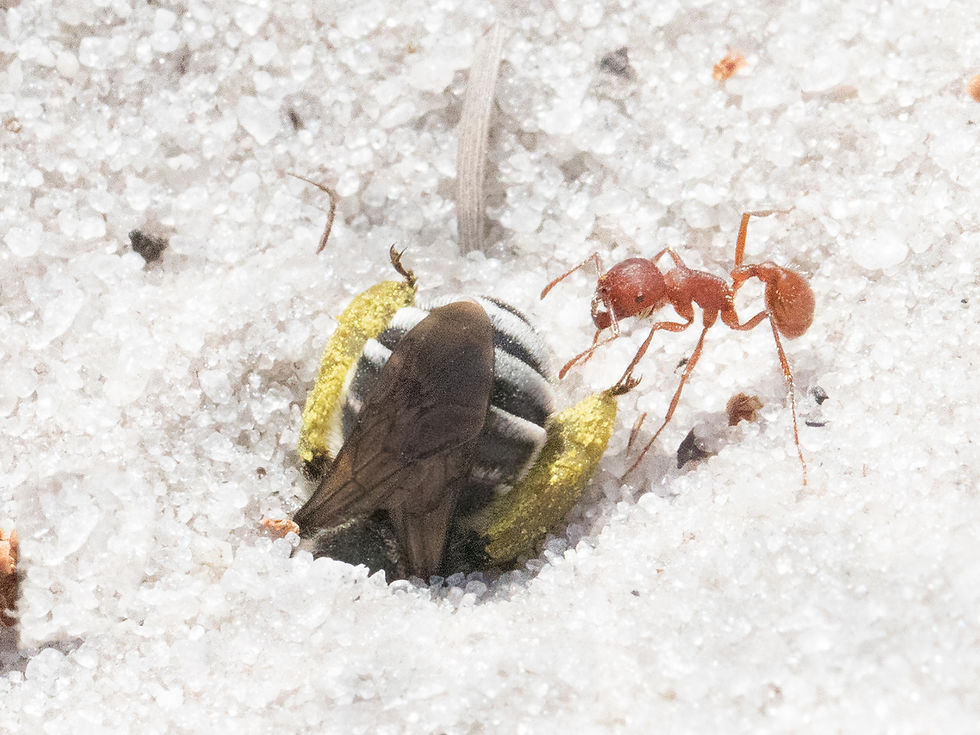

The bee rotates its body away from the ant.

After the bee nudges it, the ant backs away. No harvester ant was ever observed attempting to gain entrance to the bee nests.
All images and text protected by registered copyright.
Permissions Information