SHARP-EATMAN
NATURE
PHOTOGRAPHY
ID GUIDE TO WILD BEES
ID Page # F -B2
Mission, Texas

ORCHID BEES
Euglossa
ORCHID BEES
Euglossa
Orchid bees belong to the bee tribe Euglossini. Within the United States, they are represented by two species, the dilemma orchid bee (Euglossa dilemma), which has appeared in the southern half of FLorida within the last 20 years; and the dgreen orchid bee (Euglossa viridissima), a Mexican and Central American species that occasionally crosses the border into Texas.
Dilemma and green orchid bees are robust, noisy, brilliant iridescent-green insects with dazzling flight skills. They tend to hover in front of flowers, extending their long tongues to sip nectar. Female dlemma orchid bees gather nectar and pollen from deep-throated blossoms and iare often associated with firebush (Hamelia patens). Male dilemma orchid bees often frequent various species of porterweed as well as firebush for nectar, and they visit orchids and other flowers, such as Old World herbs like African basil, in search of floral scents.
As reported in Danforth, Minckley and Neff’s The Solitary Bees, In addition to targeting orchids, male orchid bees gather scented chemical compounds from a range of other flowers -- and also from fungi, rotting fruit, and damaged plant tissue. The male bees harvest the scented compounds using brushes on their foretarsi, and then transfer the scents, often in mid-air, to a matrix of fibers on the bees’ greatly expanded hind legs. After gathering scents, the males perch on plants, extract the scents from their hind legs and convey them to felt-like pads on their tibias. The male bees disperse the scents by fanning their wings. Such actions, if successful, attract female orchid bees, and mating follows.
According to entomologists M.S. Engel and Santiago Ramirez, the behavior of scent-collection evolved as long as 38 million years ago, and many tropical orchid species are specifically adapted to produce floral scents for the benefit of orchid bees.
Female dilemma orchid bees do not gather floral scents. They build nests in cavities found in dirt banks, rotted logs, tree trunks and even coconuts, or construct nests from resin mixed with twigs. A single female may occupy a nest, or she may share it with other females. Females have been known to cohabit a nest with daughters hatched in the nest. When those daughters mature and leg eggs, the mother bee destroys her daughters’ eggs, and thereafter, the daughters care for new eggs laid by the mother.
if you have firebush and live in near the Texas border, a simple box with a small hole, like the one shown at right, may attract nesting females to your backyard, At night, females tend to plug the boxes’ entrance holes with resin, which they push out in the morning when ready to fly.
Identifying Traits
Orchid bees of the tribe Euglossini are often green or brilliant blue, and sometimes coppery or purple. All have long tongues that reach as far as the bees' abdomens or farther. Orchid bees often carry their tongues under their bodies when at rest or in flight.
According to Michener & Danforth’s The Bee Genera of North and South America, both male and female orchid bees of the genus Euglossa tend to have jaws and labrums (the face parts between the jaws) that are whitish and clypeuses (located just above the jaws) that are also partly white. The face of a female dilemmaorchid bee is shown at right.
As noted below, all orchid bees found in Florida as of 2020 belong to the species Euglossa dilemma. Male and female dilemma orchid bees, however, may be difficult to distinguish from one another without very close inspection.
Both males and females are green with partly white faces. With the aid of a macro lens, males and females can be told apart by their hind legs: the hind legs of females are somewhat enlarged and possess pollen sacs called corbiculae. The hind legs of male bees are much more expanded, and their hind tibias each have a hairy groove that serves to aid in carrying floral compounds. The tibia of the male bee’s middle leg also has velvety patches, and the male bee's front tarsi (bottom leg segments) are brushlike. These differences are illustrated in the photo strip at right.
Species range
Euglossini and are found only in the New World. The genus Euglossa is represented by roughly one hundred and fifty species, most of them tropical or subtropical. Only two species of Euglossa have been found within the United States. One is the dilemma orchid bee (Euglossa dilemma) featured here. The other is Euglossa viridissima, a Mexican and Central American species that occasionally strays across the Mexican border into Texas and Arizona.
Within the United States, the green orchid bee (Euglossa dilemma) is found only in Florida, where it is considered an exotic species. Green orchid bees were first collected in Florida in 2003, in Broward County, by entomologists in the USDA fruitfly-monitoring program. This species in its native habitat occurs from Mexico to Western Costa Rica.
When dilemma orchid bees first appeared in Florida, they were thought to be Euglossa viridissima. In 2011, dilemma orchid bees were assigned to a new species, Euglossa dilemma. These two sister species can be difficult or impossible to distinguish, even with the aid of a macro lens. Females of these two species are nearly identical in appearance. Males differ in the number of teeth on each jaw: E. dilemma have three teeth, while E. viridissima have two.

A female dilemma orchid bee

A female dilemma orchid bee

A female dilemma orchid bee visiting porterweed

Orchid bees have robust bodies and brilliant iridescent coloring. Both orchid bees found in the United States are bright green.

A female dilemma orchid bee

The enlarged hind leg of a male dilemma orchid bee
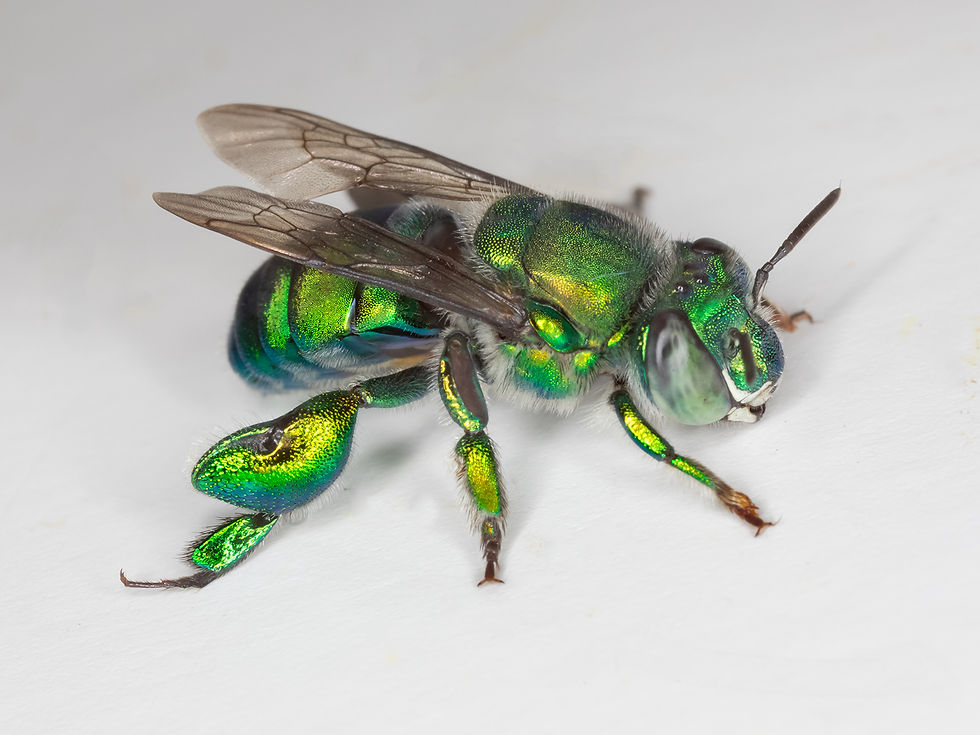
A male Euglossa dilemma

The hind leg of the male orchid bees has a greatly-enlarge tibia. The black hole in the bee's leg is the entrance to a chamber in which the bee stores scents.

Face of the male bee: orchid bees have pale markings on their jaws and other face parts (the clypeus and labrum). This male bee has pale marks on the scapes of its antennae as well. Note that this dilemma orchid bee has three teeth in each jaw -- this trait helps distinguish it from green orchid bee males, which have two teeth in each jaw.

Face of a female dilemma orchid bee
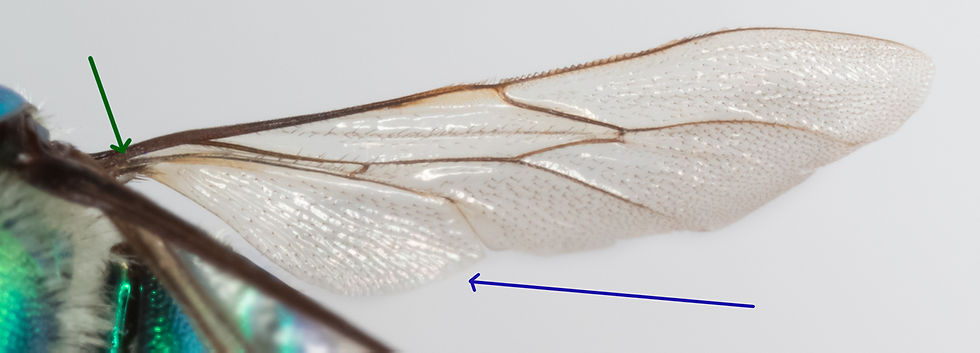
Hind wing of a female dilemma orchid bee: note that the wing lacks a jugal lobe (blue arrow). There are bristles on the inner bottom edge of the hindwings. These are defining traits of orchid bees.
Traits of orchid bees
TAXONOMY OF EUGLOSSA
Order: Hymenoptera
Family: Apidae
Subfamily: Apinae
Tribe: Euglossini
Genus: Euglossa
Species shown below:
Euglossa dilemma (Green orchid bee)
The bees shown here were identified by Jack Neff and by U C Davis, and here on i-Naturalist: by ascher and others:
Orchid Bee Species of Florida
Green Orchid Bee
Euglossa viridissima
Family: Apidae
Size: 12-13-1 mm
Associated plants at NBC:
Firebush
(Hamelia patens)
Porterweed
(Stachytarpheta mutabilis)
Plant Family: Solanaceae
When seen:
December 7, 2019 (female)
December 125 2019 (male)
Palm Bay, Florida
(Brevard County)
A female dilemma orchid bee visiting flowers
A female dilemma orchid bee

Lateral view of bee
Close-up of hind leg of female bee

A female dilemma orchid bee

A male dilemma orchid bee

A male dilemma orchid bee (Euglossa dilemma)
A male Euglossa dilemma orchid bee
Close-up of rear leg

Close-up of middle leg