SHARP-EATMAN
NATURE
PHOTOGRAPHY
ID GUIDE TO WILD BEES OF FLORIDA
ID PAGE # F11B

LEAFCUTTER BEES
Megachile xlocopoides & lanata
Leafcutter Species of FLORIDA
This bee was posted and identified on Bug Guide here:
(female) https://bugguide.net/node/view/1761239
(male): https://bugguide.net/node/view/1761044
Associated Plant:
milk pea
(Galactia
Where and when found:
Aug. 6, 2019
Palm Coast, Florida
Flagler County
NOTE YOU HAVE PHOTOS OF FEMALE IN YOUR FILES
Hoary Leafcutter Bee
Megachile pruina
(Subgenus Pseudocentron
Family: Megachilidae
Size: 12 mm (female)

A male hoary leafcutter (Megachile pruni): male leafcutters of the genus Pseudocentron have a distinctive pale stripe on the front femur.
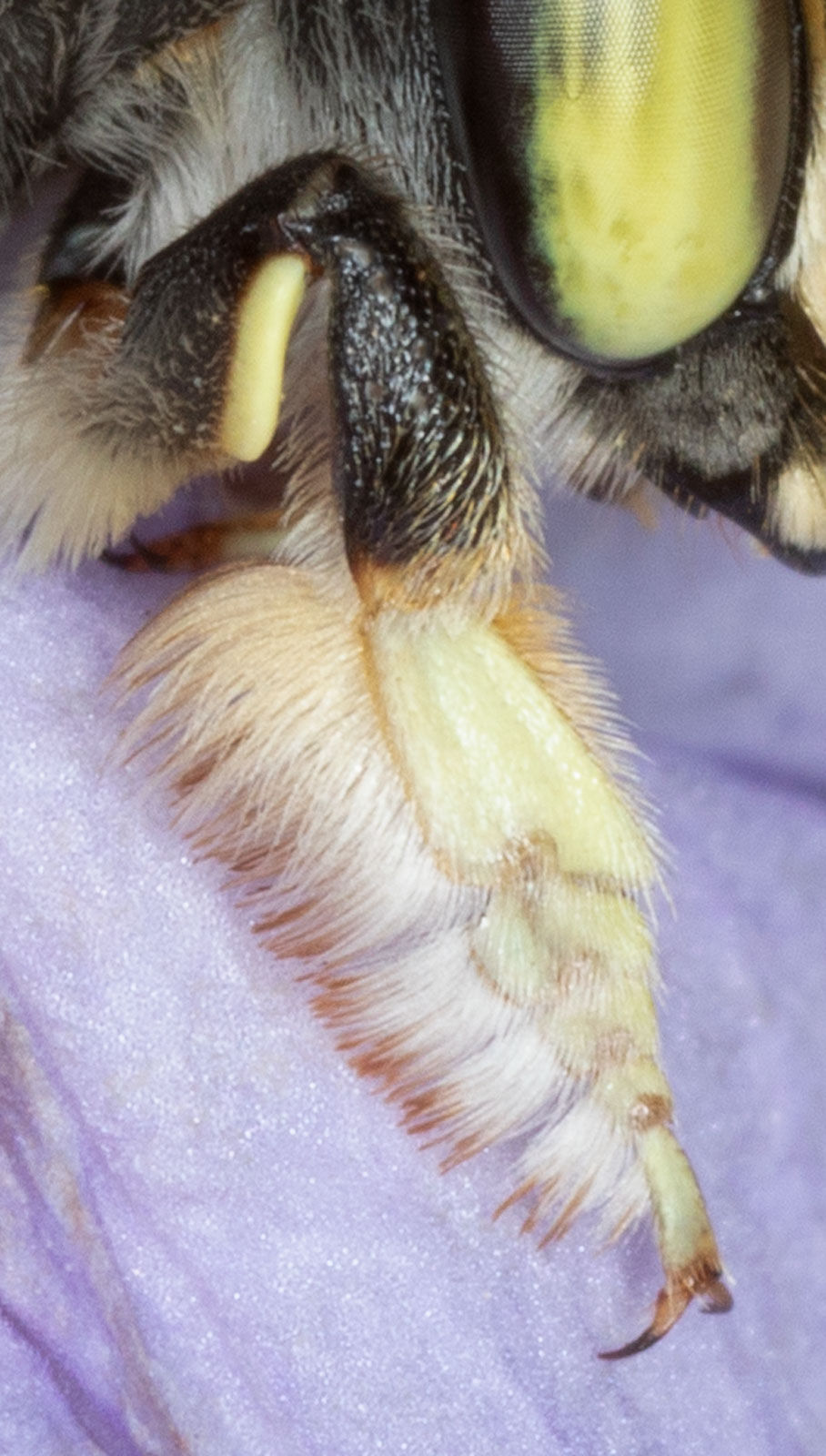
Close-up of male bee's foreleg

Face of male bee

Alternate view of face

A male Megachile pruina

A male hoary leafcutter
This 12 mm male bee has a yellow stripe on the front femur characteristic of males of the leafcutter subgenus Pseudocentron. The bee was found feeding on milkpea (Galactia), in a north Florida coastal hickory-oak hammock woodland with sandy soil.
This bee has a yellow stripe on the front femur, a characteristic of male leafcutters of the subgenus Pseudocentron. The bee was found feeding on milkpea (Galactia), in a north Florida coastal hickory-oak hammock woodland with sandy soil.
You need better photos of a female Megachile xylocopoides;
The 2014 male is posted here at iNat: https://www.inaturalist.org/observations/229204469
Carpenter mimic leafcutter
Megachile xylocopoides
(Subgenus Melanosarus)
Family: Megachilidae
Size: 14-15 mm (female)
10-13 mm (male)
Associated flora:
Snow squarestem
Melanthera nivea
Family: Asteraceae
When and where seen:
July 12, 2024
Gainesville private garden
Alachua County
Info on other two bees below:
A male carpenter mimic leafcutter bee (Megachile Xylocopoides) on lilac tasselflower (Emilia sonchifolia), Saint Johns County, Florida, June 8 2019
A female carpenter mimic leafcutter bee (Megachile Xylocopoides) on Bidens alba (romerillo), Flagler County, Florida, October 20, 2018

A male carpenter mimic leafcutter (Megachile xylocopoides)

The male Megachile xylocopoides is a black bee with a face covered with dense white hairs, and flamboyant enlarged ivory and orange frelegs.

Alternate view of bee

Close-up of face: males have 4-toothed mandibles.


A male carpenter mimic leafcutter (Megachile xylocopoides)

A male carpenter mimic leafcutter
Megachile Xylocopoides – July 12 2024 – male bee – Gainesville-K on Melanthera nivea
This is a 12 mm male carpenter mimic leafcutter bee (Megachle Xylocopoides) found feeding on snow squarestem (Melanthera nivea) in Gainesville, Florida.
This is largely black bee with dark wings tinged with bluish-purple iridescence and a face covered with dense white hairs. The bee’s forelegs have enlarged pale-yellow and orange basitarsi fringed with rust-colored hairs, and black-and-orange femurs. The abdomen is covered almost entirely with black hairs, without the pale hairbands found on many leafcutters. The first segment of the upper abdomen (T1) has long white hairs along the base. Male Megachile xylcopoides have four-toothed mandibles.
SIMILAR SPECIES:
MEGACHILE BAHAMENSIS: (PS write up for iNat: The Bahamian leafcutter (Megachile bahamensis), which occurs in the southern half of Florida, is very similar to M. Xylocopoides. Male Megachile bahamensis can be told apart from M. xylocopoides by the following traits: (1) The lower segments of the middle and hind legs of M. bahamensis are mostly pale tan and covered with pale hairs. The middle and hind leg tarsi (lowermost leg segments or "feet") are reddish. On M. xylocopoides, the lower middle and hind legs are black and covered on their outer surfaces with predominantly black or brown hairs; only a short fringe of white hair lines the front of each lower hind leg. The middle and hind leg tarsi are black. (2) Male M. bahamensis have numerous pale hairs on the sternum (underside of the abdomen); on M. xylocopides, the hairs on the sternum are black. (3) Male Megachile bahamensis also tend to run slightly smaller (11-13)
MEGACHILE MUCIDA: From Discover life: “ The male of this species is closely related to Megachile xylocopoides, but can easily be differentiated. On T6, the prominent, parallel, median ridge in xylocopoides is deeply notched with the sides of that notch drawn up into narrow prongs. Mucida is also notched, but other than the notch, the ridge is evenly rounded out. It has no prong like structures on the ridge. “
Megachile mucida males also have foretarsi that are all yellow or nearly all yellow. The front femurs are largely orange on the outer surface. (These are black on M. xylocopides.) Like M. xylocopoides, the tips of their antennae (F11) are spatulate (expanded). (There are no clear photos of this species on DL, iNat or Bug guide.) Your pictures of M mucida / melaophea are the closest thing: https://bugguide.net/node/view/1355124
ADDITIONAL DESCRIPTIVE INFO:
This is a 12 mm largely black male bee with black wings tinged with blueish-purple iridescence and a face covered with dense white hairs. The bee’s forelegs have enlarged pale-yellow basitarsi fringed with short rust-colored hairs. Its front femurs are fringed with long yellowish-white hairs; and its front tarsi ar yellowish. The bee’s forelegs have enlarged pale-yellow basitarsi fringed with short rust-colored hairs and femurs that are black and orange. The middle and hind legs are black; the low mid legs are partly covered with brown hairs, and the hind legs with black hairs and a fringe of white hairs. The bee’s thorax is black and pitted and The bee’s abdomen is covered almost entirely with black hairs (both on the upper surface and underneath on the sternum) except on the first segment (T1) which is covered with white hairs at the base. The male bee’s middle and hind legs are mostly black, sometimes with dark red markings, and covered with black and and brown hairs. Male Megachile xylcopoides have four-toothed mandibles. F11 of the antennae is spatulate (widened and flattened).
MORE INFO ON OTHER SIMILAR FLORIDA LEAFCUTTERS:
Five native Megachile species in Florida t have all-black abdomens with no pale hair bands:
Megachile Xylocopoides, M. bahamensis, M. gemula, M. frigida and M. sculpturalis.
There are only five Florid leafcutter species with all-black or mostly black abdomens that lack bands of pale hair: Megachile xylocopoides, Megachile bahamensis, Megachile mucida, Megachile frigida and Megachile gemula, and the non-native Megachile sculpturalis.
Megachile gemula males lack expanded, pale forelegs.
Megachile frigida males have two distinct parallel brown or black lines that run lengthwise down the front face of each femur.
Megachile sculpturalis, a very large non-native bee also has an entirely black abdomen, but can be differentiated by its much larger size, the lack of any white hairs on the abdomen, its lack of white expanded forelegs, and its 5-toothed mandibles. THREE TOOTHED?
ATTRIBUTES OF MELANOSARUS
U FLORIDA KEY: https://entnemdept.ufl.edu/hallg/melitto/floridabees/megachile.htm
EXOTIC BEE ID: https://idtools.org/exotic_bee/index.cfm?packageID=1189&entityID=9171
- middle leg spur is absent
- punctures of scutum usually well separated, but, if close, then individually distinguishable
- Male front tarsi are distinctly expanded and pale.
The subgenus Megachile (Melanosarus) contains eight species, two in the U.S. (Michener 2007).
Similar subgenera: Some Xanthosarus and Pseudocentron are similar in appearance.
BEHAVIOR
[Exotic Bee ID:] Megachile (Melanosarus) nests in pre-existing cavities, including in bamboo and cardboard trap nests (Eickwort et al. 1981; Marques and Gaglianone 2013). They have been observed constructing their nests from pieces of cut leaves (Marques and Gaglianone 2013).
Megachile xylocopoides is the host of Coelioxys dolichos.
This bee was posted and identified on Bug Guide here:
(female) https://bugguide.net/node/view/1761239
(male): https://bugguide.net/node/view/1761044
Associated Plant:
sunn hemp
(Crotolaria juncea)
Where and when found:
Dec 6, 2019
Palm Bay, Florida
Brevard County
Woolly wall bee
Megachile lanata
(Subgenus Pseudomegachile)
Family: Megachilidae
Size: 16 mm (female)
14 mm (male)

A female woolly wall bee (Megachile lanata)

Male woolly wall bees on crotolaria

A male woolly wall bee: note the bright orange thorax hairs.

A female woolly wall bee: the female leafcutter bee is large with a long, narrow body. Most of its head and thorax, and part of its abdomen are covered with bright rust-orange hairs.

Face of female bee: the female has f4-toothed mandibles. Rust-colored hairs cover most of its face.

A male woolly wall bee (Megachile lanata)
Megachile lanata, Dec 2019, Palm Bay, on Crotolaria – File no.s FLA 2019 #101 & 102 (intermised with TX NBA files)
These Megachile lanata (Woolly wall bees), a kind of non-native leafcutter bee, were found feeding on A on sunn hemp (Crotolaria juncea), Palm Bay, Florida, Dec 2019.. Female is 16 mm and male is 14 mm
YOU HAVE EXTENISE NOTES & ARTICLES ON THIS SPECIES:
Here is your blurb:
Your summary, based on the DLD & below: Megachile lanata, also known as the woolly wall bee, is a beautiful, but non-native, leafcutter bee, originating in southeast Asia. It was first described by Fabicius in 1775 and arrived in the West Indies on trade ships in the 1800’s pr possible earlier. Sometimes referred to as a “tramp species,” it is well-established in many Caribbean islands, and has spread as far as northern south America. It is a recent migrant to south Florida and Hawaii.
Megachile lanata is an important crop pollinator in southeast Asia, important to hemp production. It is a generalist pollinator, but in Florida is closely associated with non-native crotolaria. It also visits common Florida ornamentals such as esperanza (Tecoma stans), golden dewdrops (Duranta erecta) and firebush (Hamelia patens). The bee shown here was feeding on sunn hemp (Crotolaria juncea) with dozens of other Megachile lanata males and females.
This is an easily identified leafcutter. It is fairly large; the male shown here was 14 mm, and the females are as large as 16 mm. The hairs on the bee’s head, thorax and part of its abdomen are bright rust-red.
CITE THIS PAGE: Sharp, Paula and Ross Eatman. "Megachile." Wild Bees of the National Butterfly Center of Mission, Texas. 15 Jan. 2019, http://www.wildbeestexas.com. Accessed [day/month/year guide accessed].