SHARP-EATMAN
NATURE
PHOTOGRAPHY
WRITE 2026 TEXT ABOUT T. KATHRYNAE & MEXICANUS HERE
Associated flora:
Texas kidneywood
(Eysenhardtia texana)
Plant Family: Fabaceae
When and where seen:
May 23, 2025
La Puerta Tract
Rio Grande City, TX
(Starr Co.)
Kathryn's Triepeolus
Triepeolus kathrynae
Family: Apidae
Size: 12-13 mm (males and females)

A black male Triepeolus kathrynae from Starr Co. Texas

Protoxaea gloriosa, the host bee of Triepeolus kathrynae.

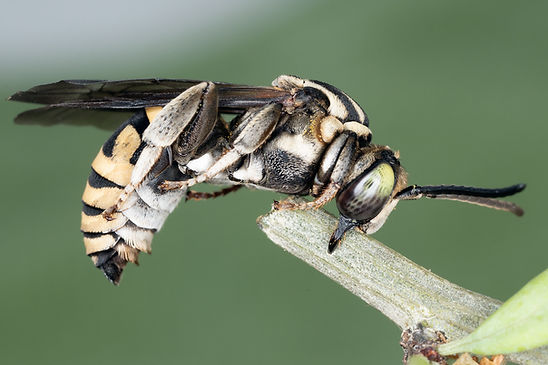
This is a male Triepeolus kathrynae, found in May 2025 at La Puerta Tract (Starr Co.). Note the yellowish coloring of the abdominal bands, a trait of the species Triepeolus kathrynae. Photo copyright 2025 Dan Jones.

Alternate view of bee: this bee lacks the red legs typical of the species. Such color variations occur in many Triepeolus species that are typically partly red. Photo copyright 2025 Dan Jones.

This is a male Triepeolus kathrynae found in Arizona in August 2025, feeding on acacia. This bee has the typical coloration of the species -- its legs are reddish rather than black.

Close-up lateral view of the same Arizona bee. Photo Copyright 2026 by Ken Kertell.

This pinned specimen of a second male Triepeolus kathrynae from Arizona also has the red legs typical of the species. Photo copyright 2023 Sam Wilhelm.
Recommended References
on Triepeolus kathrynae:
Cresson, E.T. 1878. Descriptions of new North American Hymenoptera in the collection of the American Entomological Society". Trans. Amer. Ent. Soc. (Co. Paper 401):61-135. Link.
Onuferko, T.M., & M.G. Rightmyer. 2024. A revision of the simplex species group of the cleptoparasitic bee genus Triepeolus Robertson, 1901 (Hymenoptera: Apidae). European Journal of Taxonomy 950(1): 1–106. Link.
Rightmyer, M.G. 2008. A review of the cleptoparasitic bee genus Triepeolus (Hymenoptera: Apidae). Part I. Zootaxa 1710(1): 1–170. Link.
Rozen J.G. Jr. 1989. Two new species and the redescription of another species of the cleptoparasitic bee genus Triepeolus with notes on their immature stages (Anthophoridae: Nomadinae). American Museum Novitates 2956: 1–18. Link.
See also: Comments by Thomas Onuferko and John Ascher dated Dec. 21, 2025 on photographs of Dan Jones. iNaturalist. May 23, 2025. And Accessed 12-21-25. Link.
Photo Copyright 2026 Dan Jones

A red-legged male Triepeolus kathrynae from Arizona
Photo Copyright 2026 Ken Kertell
Records of Triepeolus kathrynae in the Lower Rio Grande Valley are relatively recent. On May 23, 2025, expert nature photographer Dan Jones posted on i-Naturalist photographs of a large black Triepeolus with yellowish hair bands that he had found at La Puerta Tract (Starr Co.). This bee (shown here in the first photo strip) was identified as Triepeolus kathrynae by Epeolini expert Thomas Onuferko, who accompanied the ID with useful commentary summarizing the distinctive traits of the species.
Before then, the closest Mexican record of Triepeolus kathrynae was of a male found in 1951 in Vallecillo, Nuevo Leon (approx. 88 miles from La Puerta). There are limited Texas records of Triepeolus kathrynae: it was documented decades ago in Culberson County (1963) and Dimmit County (1943), situated approximately 600 and 120 miles respectively from Starr County.
Information on the species Triepeolus kathrynae
Tripeoelus kathrynae was first described in 1989 by renowned entomologist Jerome Rozen, Jr., curator of the Apoidea Collection of the American Museum of Natural History. He named the bee after his granddaughter.
In 2024, the European Journal of Taxonomy published an article coauthored by Epeolini experts Thomas Onuferko and Molly Rightmyer. Titled "A revision of the simplex species group of the cleptoparasitic bee genus Triepeolus Robertson, 1901," the new work described 18 Triepeolus species, among them T. kathrynae. The 1984 revision provided extensive information on the physical characteristics of T. kathrynae and summarized behavioral and geographical information relating to the species.
General traits. Triepeolus kathrynae is a relatively large, mostly black to dark brown cuckoo bee with patterns formed by pale-yellow hairs on its thorax and abdomen. The bee's wings are glassy and dusky.
Typically, Tripeolus kathrynae are partly red or reddish. Onuferko & RIghtmyer (2024) describe Triepeolus kathrynae as having red or reddish coloring as follows. The mandibles are partly orange and golden yellow; F1 of the antennae is orangish red, and F2 has an orange spot at the base. These parts of the bee are also typically all or partly orangish red: the legs: the sides of the abdomen; the pygidial plate (on the tip of the abdomen); and the sternum. The tegulae (plates where the wings join the thorax are reddish brown. Photographer Ken Ketrell and biologist Sam Wilhelm have provided photographs here (in the second photo strip) (in the second photo strip, ) of two typical examples of Triepeolus kathryne from Arizona that have partly red coloration (shown in the second photo strip.
Coloration may vary, however, on individual specimens of Triepeolus kathrynae. The bee shown here from La Puerta Tract is entirely black.
DIstinctive traits. Distinguishing this species from similar species can be tricky, particularly in individuals that lack red coloration. Species diagnosis may turn on minute traits of the axillae and sternum.
Traits of the axillae. Axillae, shown in the photographs here, are tooth-shaped features on the rear of the scutellum (the second thorax segment). Onuferko & Rightmyer (2024) emphasized traits of the axillae as distinctive features of Triepeolus kathrynae. They noted that on Triepeolus kathrynae, the axillae have pale hairs "all along" their margins; they are large, pointed and hooked; their tips extend well beyond the mid-length of the scutellum; and at least half of the mesal (inner) edges of the axillae are unattached to the scutellum.
Traits of the sternum: Triepeolus kathrynae possesses a second distinctive trait highlighted by both Rozen (1989) and Onuferko & Rightmyer (2024): on males, the rear edges of S4–S5 (the fourth and fifth segments of the sternum, or underside of the abdomen) have fringes of dense, long, curved, coppery to silvery hairs. The third sternal segment (S3) lacks such hairs.
Range: Within the United States, Triepeolus kathrynae is most often found along the US-Mexico border in Arizona, New Mexico and Texas. Its range extends southward into Mexico as far as Guerrero. There are records of Triepeolus kathrynae from the Mexican states of Baja California, Chihuahua, Durango, Guerrero, Jalisco, Nuevo Leon, Sonora and Morelos.
HProtoxea gloriosa, has been documented at La Puerta Tract and elsewhere in the Lower Rio Grande Valley.
Associated flora
Guajillo
(Senegalia berlandieri)
Plant Family: Fabaceae
When and where seen:
May 16, 2021
La Puerta Tract NWR
(Starr County)
Zacatec Triepeolus
or Kathryn's Triepeolus
Triepeolus zacatecus/
Triepeolus kathrynae
Family: Apidae
Size: 16.5 mm (this speciment)
Typical size: 14-17 mm (female & male)

A male Triepeolus zacatecus / kathrynae: this is a large bee, measuring approximately 16.5 mm. Its head, body and legs are black. Its tegulae are also black and its wings smoky and dark-veined.

Dorsal view of the pattern formed on the bee's thorax by appressed, white hairs: the long axillae are sharply incurved at the tips, and fringed on both the outer and inner margins with white hairs.

Lateral view of head and thorax of male bee

Face of male bee
A 16.5 mm male Triepeolus zacatecus / kathrynae
Triepeolus zacatecus
The male bee specimen featured here, found in Starr County's La Puerta Tract, was originally identified in 2021 as Triepeolus zacatecus and appears under this name in Native Bees of the Lower Rio Grande Valley. This species had been documented previously in Tamaulipas, the Mexican state that borders Starr County and lies a mere 1-2 miles from La Puerta Tract. This species ranges from Tamaulipas to Mexico's southern border, and it has been found as far South in Central America as Costa Rica.
Triepeolus zacatecus is a large (14-17 mm), black bee with patterns of short pale-yellow hairs on the thorax and abdomen. The bee shown here stood out in the field because of its exceptional size (16.5 mm).
Cresson first described a female of the species in 1878. Triepeolus zacatecus is distinguished in part by three minute traits. (1) The axillae are long and sharply incurved. (Axillae are toothlike projections at the back of the second thorax segment, shown in the photo strip here). (2) The pronotal collar (at the front of the thorax) is wide and protuberant. (3) The mesepisternum (side of the thorax) is covered with short, dense hairs. All of these are traits of the male bee shown here. (4) A fourth distinctive trait of T. zacatecas, is the presence of long, erect, simple setae on the mesopleura (long hairs on the rearmost part of the thorax, where it joins the abdomen). This trait is not evident on the bee shown here.
Triepeolus zacatecus is very similar to T. grandis, another exceptionally large Triepeolus. The two species differ principally in coloration, and in minor traits. The female T. grandis has narrower bands on T1-T2 and shorter axillar spines. Notably, on both T. grandis and T. zacatecuas, the axillae have a fringe of white hairs along the inner margins, but not on the outer marsins. (Rozen 1985; Onuferko & RIghmyer 2024) . On T. grandisdid not have hairs along its axillae this trait; Onuferko & RIghtmyer (2024) noted that the inner margins of the axillae are "outlined with white setae".
Triepeolus kathyrnae
In her comprehensive 2008 revision of the genus Triepeolus, Rightmyer (2008) described Triepeolus zacatecus and noted that it is "superficially similar to T. kathrynae (in the T. simplex species group), due to the very long axillar spines, the yellow coloration, and the robust body form." She also noted that females can be easily separated by traits of the abdomen. (The pseudopygidial area is apically concave in T. kathrynae). Differences among males are not discussed.
As noted above, In 2024, the European Journal of Taxonomy published an article coauthored by Epeolini expert Thomas Onuferko and Molly Rightmyer that contained a detailed description of T. kathrynae. Shortly after the publication of this article, a male Triepeolus kathrynae found at La Puerta tract (shown directly above) was identified on i-Naturalist.
This prompted a reeamination of the species diagnosis of the large Triepeolus shown here. This bee possesses at least two of the defining characteristics of T. kathrynae described in the website entry above relating to the latter species. (1) Axillae: As shown in the photo strip here, there are hairs all along both sides of the bee's axillae (rather than on just the inner margins). (2) Sternum: The rear edges of S4–S5 (the fourth and fifth segments of the sternum, or underside of the abdomen) have fringes of dense, long, curved, coppery to silvery hairs. The third sternal segment (S3), however, lacks such hairs. S3-S5 of Triepeolus zacatecus, by contrast, is fringed with hair that Rightmyer (2008) describes as "white and sometimes reduced on S3, brown to pale golden on S4–S5.”) On the bee shown here, S3 lacks such hairs.
For these reasons, it is probable but uncertain that the bee shown here is T. kathrynae. Some questions remain about this species diagnosis. Most notably, this bee is considerably larger (16.5) than the typical length (12-13 mm) of the male Triepeolus kathrynae. Its integument is also entirely black, while T. kathrynae typically has red legs and reddish coloration on parts of the face, antennae and abdomen. Nonetheless, Triepeolus species that are typically partly red can have all-black variants. An example is the T. kathrynae shown in the above entry on that species.
Host: The host species of Triepeolus zacatecus is unknown. as noted in the entry above, Triepeolus kathrynae is thought to be a brood parasite of Protoxea. One species of this genus, Protoxea gloriosa, has been documented at La Puerta Tract.
CITE THIS PAGE: Sharp, Paula and Ross Eatman. "Epeolus and Triepeolus." Wild Bees of the National Butterfly Center of Mission, Texas. 15 Jan. 2019, http://www.wildbeestexas.com. Accessed [day/month/year guide accessed].